

Executive summary
In recent years, the sheer pace of economic change and rising public interest in entrepreneurship and tech have only heightened the importance of accurate, balanced reporting. One of our guiding missions at The Entrepreneurs Network is to champion the role of entrepreneurs in the media and public debate, and yet as we document in this briefing, large portions of Britain’s founder community believe our media landscape is falling short.
With support from Pathos Communications and in partnership with Public First, we surveyed founders from our network to understand how they view the quality, quantity and focus of national media coverage of entrepreneurship. Founders overwhelmingly feel that journalists do not do a good job covering entrepreneurship – for every one founder who believes coverage is good, around five think the opposite. They also believe that the quality and volume of reporting have not improved in recent years, and that the issues most important to entrepreneurs rarely receive appropriate attention.
Yet founders are aware of their own weaknesses. Many acknowledge that entrepreneurs themselves do not always represent their work effectively in the media, suggesting that the relationship between journalism and entrepreneurship is a two-way street in need of improvement.
Their qualitative responses point to five priorities for change. Founders want journalists to celebrate a broader range of entrepreneurs; give a more honest account of the realities of building a business; adopt a healthier tone towards success and wealth creation; develop a deeper understanding of the fundamentals of entrepreneurship; and widen the diversity of sectors, regions and stories they cover.
If policymakers increasingly form their views of business through the stories they read, then the media’s portrayal of entrepreneurship matters – for investment, for innovation, and for the next generation of founders. Media narratives help shape perceptions of risk-taking, economic dynamism and the societal value of entrepreneurial activity, influencing everything from public sentiment to political decision-making. A better-informed, more balanced media landscape would serve both business and the public interest. Over time, we think this would contribute to a healthier entrepreneurial culture in which success is understood, supported and more widely encouraged.
Introduction
Whether we like it or not, media matters for entrepreneurs. For founders themselves, coverage by a prominent journalist could be a blessing or a curse. A positive profile might lead to more sales or fresh investment interest, while a negative exposé could cause things to come crashing down.
More broadly, how entrepreneurs are reported on, and which parts of the entrepreneurship landscape get covered, can have significant consequences for the whole startup ecosystem if it influences policy direction one way or another. Given the majority of Members of Parliament have no prior experience of running a business, how journalists cover entrepreneurship in the papers they read will have profound importance for how legislative decisions ultimately get made. A reliance on mediated information means that gaps, distortions, or recurring tropes in coverage can all too easily be reflected in policymaking.
Coverage may also influence whether any given individual takes the plunge and starts a business of their own – which will impact the kinds and number of people who ultimately make up the UK’s entrepreneurial ecosystem. A media environment that regularly showcases only extreme successes or dramatic failures may unintentionally deter otherwise capable would-be founders who do not see their own aspirations reflected.
With support from Pathos Communications, and partnering with Public First, we asked founders in our network to give their opinions on a range of questions about the intersection of the national media and entrepreneurship. We gathered both quantitative and qualitative insights, capturing not only what founders think but also why they think it. In this short briefing paper, we report and reflect on what they told us. Our aim is not to apportion blame. Rather, we want to use the research to contribute to a more informed discussion about how the relationship between the media and the entrepreneurial community can be strengthened in the years ahead.
Key findings
For most of us in society, journalists are the medium through which we learn about the nuts and bolts of what’s really going on in the private sector. Depending on the stories they opt to cover, and the companies, sectors or trends they choose to focus on, business reporters hold considerable sway over how the wider public thinks about enterprise. And of course, for every issue that does get investigated, there are many more that go underreported.
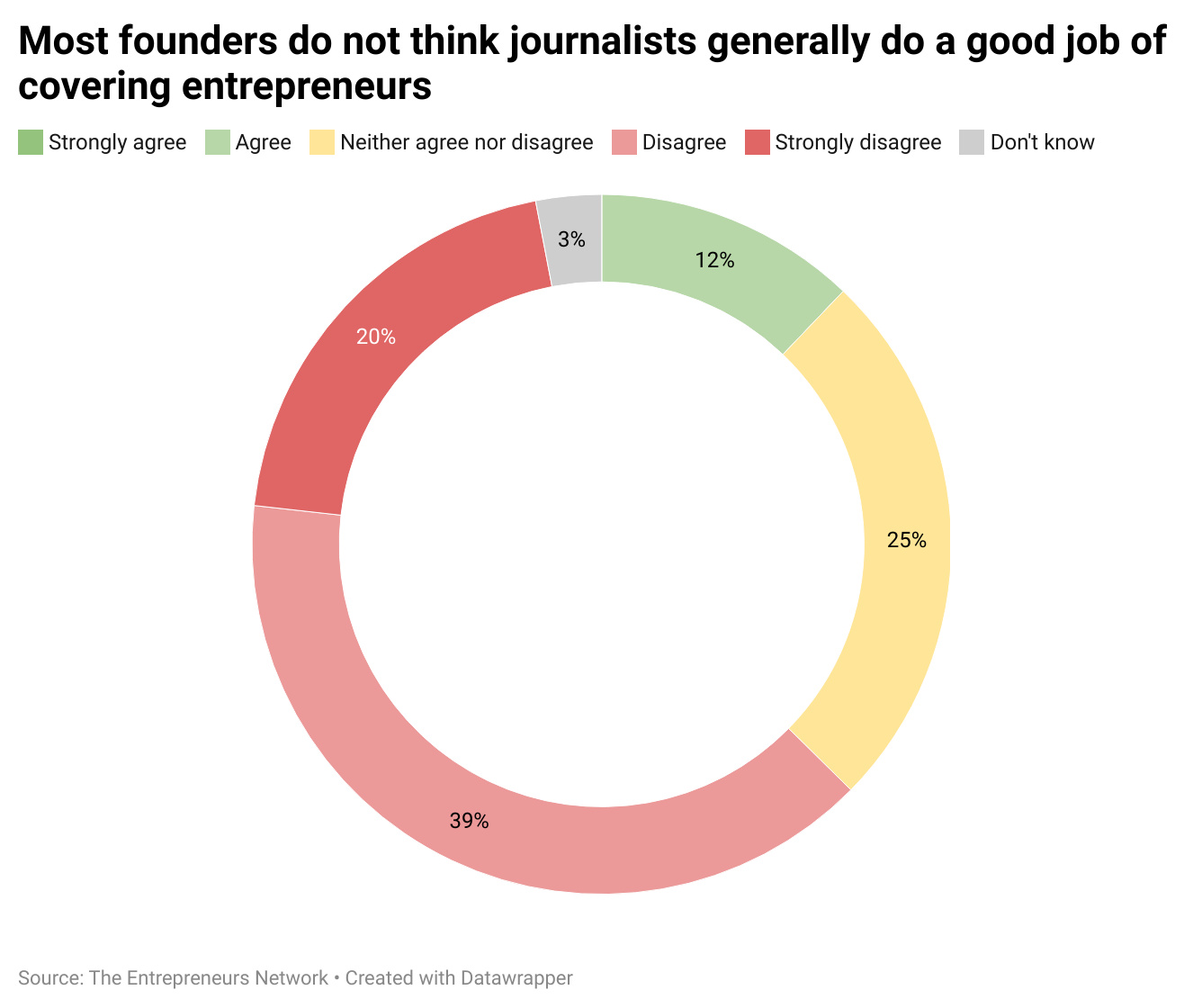
In our first question we posed to founders, we asked them how well they thought journalists cover entrepreneurs in general. The responses we got did not make for pretty reading. Nearly three in five (60%) said they disagreed that journalists generally do a good job on this front, with a fifth (20%) strongly disagreeing. A quarter (25%) said they neither agreed nor disagreed with the statement. Just 12% agreed that journalists generally do a good job, and 0.4% said they strongly agreed they do. In other words, for around every one founder who thinks journalists do a good job covering entrepreneurship, five think the opposite.
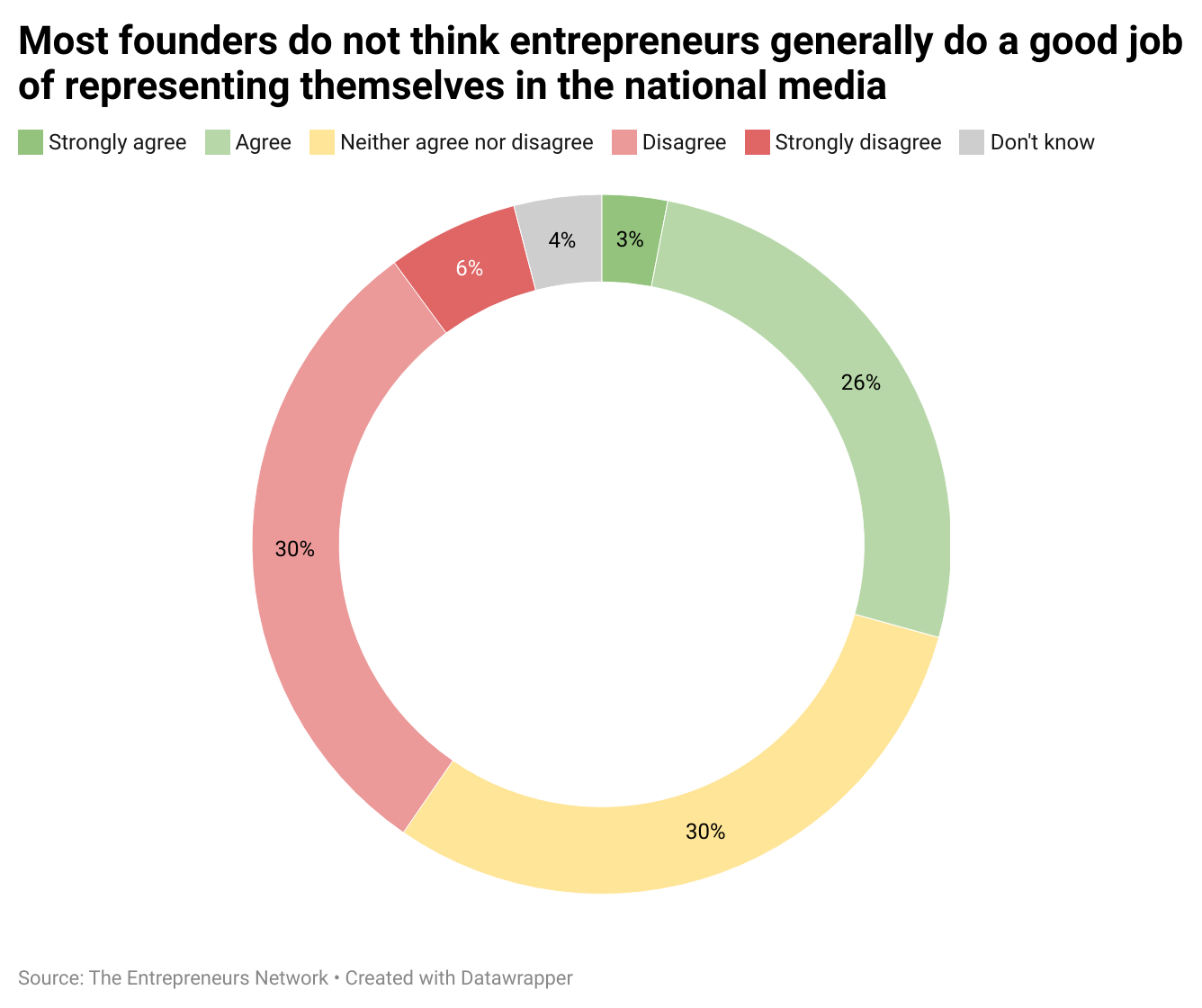
While it’s easy to criticise others, we also wanted to turn the tables on the founders in our sample. We therefore asked them how well they thought entrepreneurs represent themselves in the national media. Here, interestingly, slightly more founders disagreed that entrepreneurs do a good job (36%) than agreed (30%). Nearly a third (30%) neither agreed nor disagreed. What we might deduce from this data is the impression that many founders are not oblivious to the idea that they themselves need to up their game when it comes to representing themselves in the media.
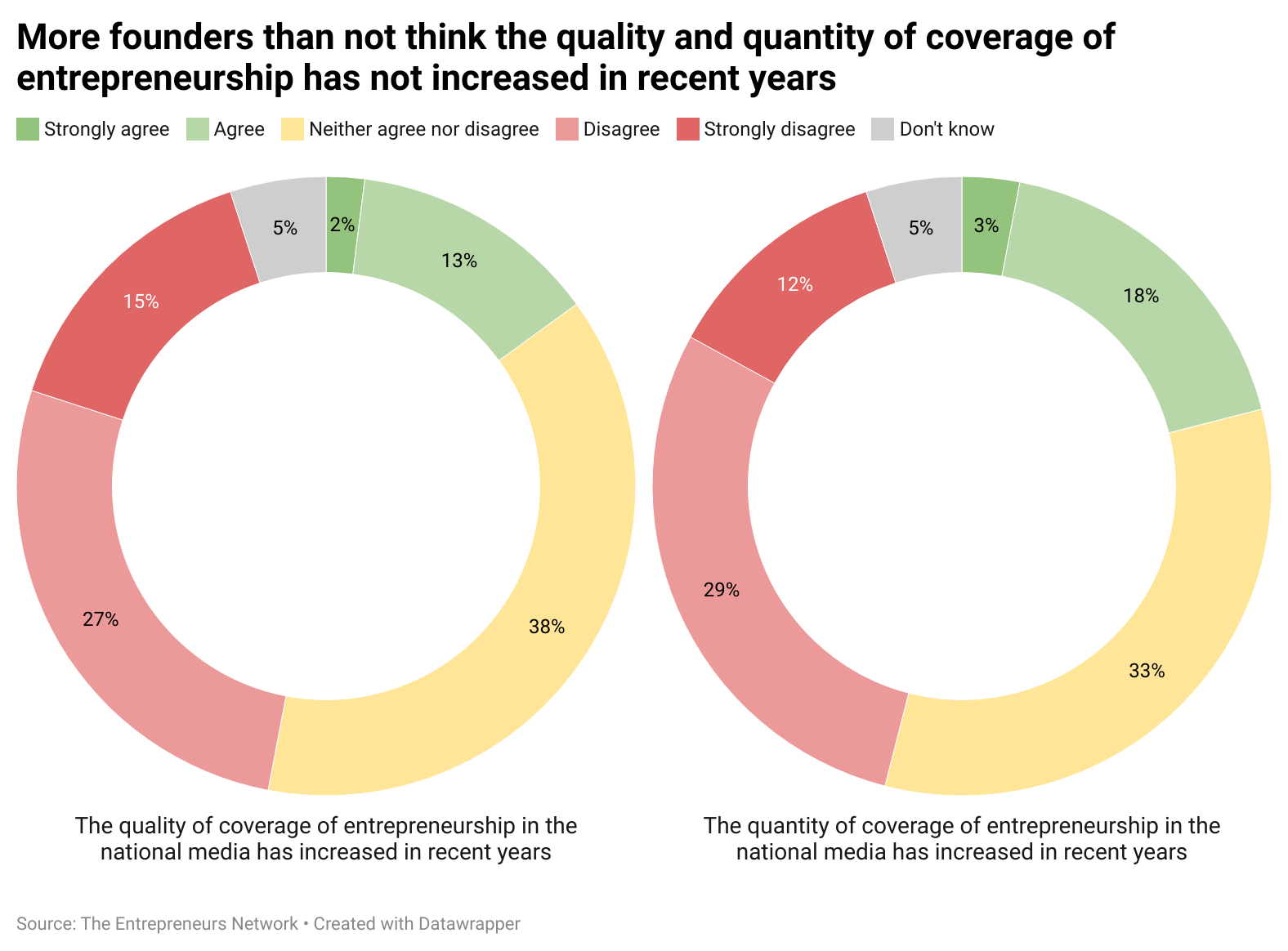
We then asked founders for their views on how both the quality and quantity of coverage of entrepreneurship has changed in recent years. With respect to quality, 42% disagreed that it had increased in recent years, while 38% neither agreed nor disagreed, and just 15% agreed. With respect to quantity, 21% agreed it had increased, compared to 33% who neither agreed nor disagreed, and 40% who disagreed. In short, on average, founders do not think coverage of entrepreneurship is getting any better either in terms of the volume or standards of reporting.
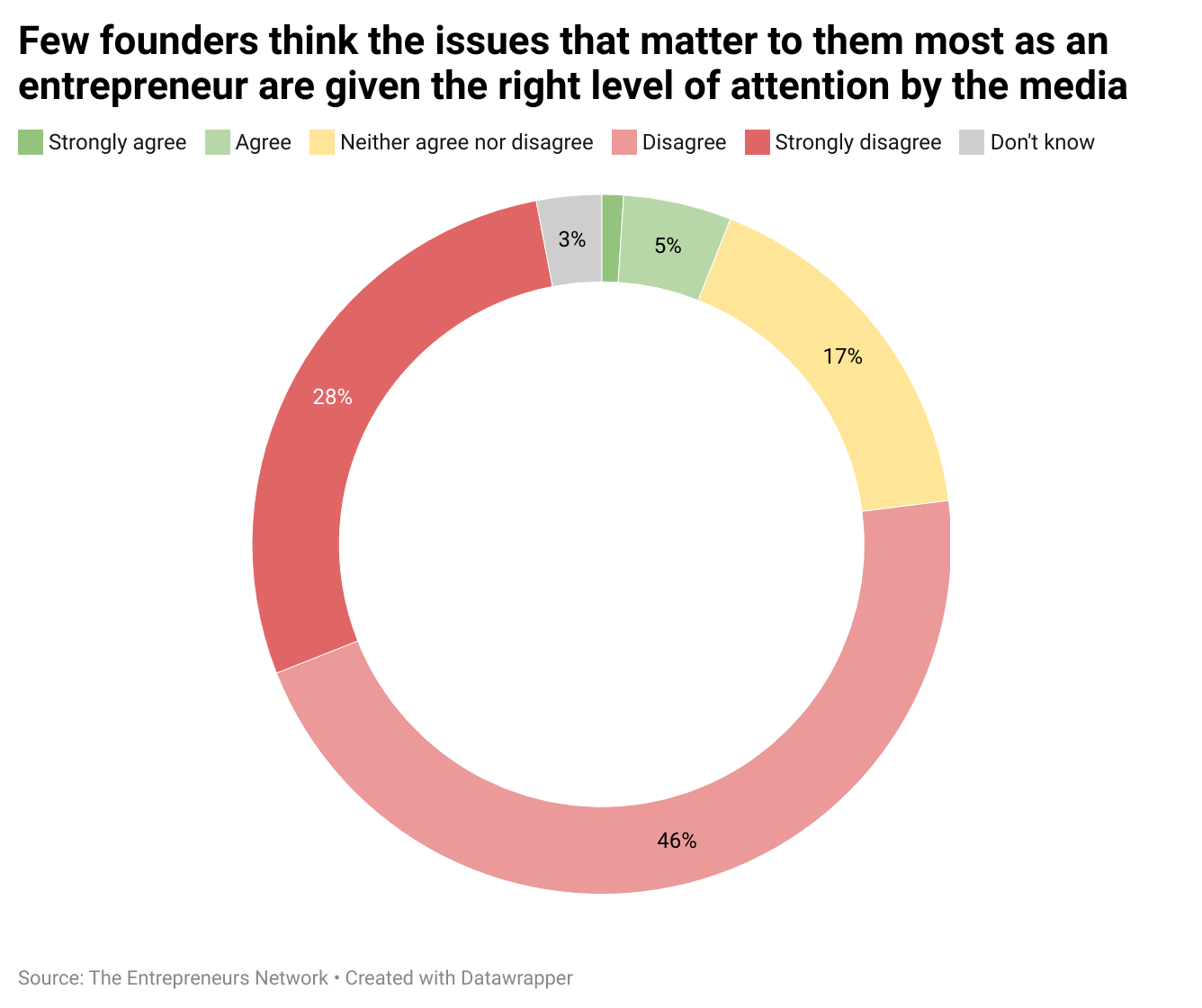
Finally, we were keen to know whether founders think journalists are focusing on the most important topics in their reporting. The responses we received categorically suggest not. More than seven in 10 (74%) founders disagreed that the issues that matter to them most as an entrepreneur are given the right level of attention in the national media. In contrast, just 6% of founders agreed the issues were, while 17% neither agreed nor disagreed. If there was just one takeaway from all of the questions we posed to the founders in our sample, this finding was perhaps the most striking and strongly voiced.
On all of these questions, we also looked whether there were differences in responses depending on the type of founder we asked. While there were sometimes marginal variations, no matter the founder’s gender, age or time they’d been running their business, or whether their business was R&D intensive, or the number of employees they had, the broad thrust of responses were remarkably uniform.
In addition to gathering quantitative data from our founders, we also wanted to let them give their perspectives in their own words. Specifically, we asked our sample to tell us how, if at all, they would like to see coverage of entrepreneurs in the national media change. Sifting through the responses we received, five broad themes emerged:
Celebrate everyday entrepreneurs, not just unicorn founders. Many founders remarked about how they feel too much attention goes towards highly accomplished entrepreneurs, and not enough to those building more gradually. While attaining large valuations is certainly praiseworthy, it is not the only metric of success. As one respondent put it: “Too often the focus is on tech unicorns or celebrity entrepreneurs, while the vast majority of small and medium-sized businesses that create jobs and drive local economies are overlooked.”
Cover the realities of building a business. Instead of fixating on funding rounds, founders also told us how they would appreciate it if more journalists considered covering the less glamorous aspects of enterprise. Functions such as hiring and bureaucracy might be superficially more mundane, but they are the building blocks of running a business – and something all entrepreneurs need to be aware of. To quote one founder: “I’d like to see the national media broaden its coverage of entrepreneurs beyond the usual focus on venture-backed startups raising large rounds of funding. While those stories matter, they don’t reflect the full reality of entrepreneurship. Immigrant founders, small business owners and people who build bootstrapped companies are often left out, even though their work creates jobs, drives local economies and often has a lasting social impact.”
Strike a better tone towards wealth creation. When they do succeed, many entrepreneurs wished journalists wouldn’t immediately try to tear them down. Entrepreneurs seldom capture much of the value they bequeath to society – whether it’s jobs they provide or innovations they develop – and a more relaxed stance to wealth creation would incentivise success. In the words of one founder: “We need a culture of celebrating success in entrepreneurship and for people to know that people have the agency and ability to create wealth themselves by creating value in society and the economy. Entrepreneurs create jobs and take on considerable personal risk and challenge.”
Gain a deeper knowledge of entrepreneurship. Founders felt that not enough journalists understand the fundamentals of entrepreneurship. Many entrepreneurs told us how while they don’t expect journalists to know all the ins and outs of running a startup, too much reporting still confuses basic elements of the business world. As one founder wrote: “[G]enerally journalists only talk with a few larger company leaders. There is a distinct lack of understanding of the key economic drivers which impact, or might impact, the choices made by government.”
Increase the diversity of what and who is represented. As the saying goes, you can’t be what you can’t see, so it was no surprise when entrepreneurs told us that they’d appreciate journalists broadening their focus beyond sectors like tech or geographies like London and the South East. To quote one founder: “Sectors such as fintech and consumer apps receive disproportionate attention, while areas like healthcare technology, education, clean energy and advanced manufacturing are under-reported, despite their significance.”
Conclusion
Our research reveals a clear message: entrepreneurs do not feel represented by Britain’s national media. Across every question we asked, founders expressed a sense that coverage is too narrow, too shallow and too disconnected from their realities of building and running a business. This sense of disconnect was evident irrespective of founder profile (age, gender or business characteristics), suggesting that the issue is systemic rather than confined to any particular group of entrepreneurs.
This matters. Media narratives shape how the public views entrepreneurship, influence whether future founders take the initial leap into starting up and help determine how policymakers perceive the challenges businesses face. In an age where headlines often travel further and faster than detailed analysis, these narratives can become the dominant frames through which entrepreneurship is understood. When coverage fixates on a handful of unicorns, sensational failures or funding-round theatre, it distorts the picture of what most entrepreneurs do – and what they require. The cumulative effect is a public conversation that risks overlooking the slow, incremental work that actually drives economic growth and innovation.
The founders we surveyed are not asking to be showered with attention or given a carve out from scrutiny. Rather, most of the calls we heard were simply for greater accuracy, breadth and balance. Coverage, they told us, should strive to reflect the everyday experience of building a company – recognising that risk-taking and wealth creation are positive forces for good. Many founders stressed that constructive examination is both necessary and welcome, provided it is rooted in a genuine understanding of how businesses operate in practice. Journalism that is curious about the full diversity of sectors and regions that make up Britain’s economy would also help. A richer and more representative media ecosystem would help surface stories that currently struggle to find a platform, offering the public a fuller picture of where new ideas and opportunities are emerging.
Improving this landscape will require effort on both sides. For journalists, while we are not oblivious that forces beyond their control will likely always push them towards covering the most eye-catching stories, they could be minded to devote more attention to the middle of the entrepreneurial distribution, deepen their understanding of the policy and economic context in which founders operate, and widen the range of voices they draw on. This might involve spending more time speaking with early-stage founders, exploring lesser-known industries or engaging with regional business communities beyond the usual hubs.
Entrepreneurs, meanwhile, could do better to tell their stories more clearly, transparently and accessibly. By investing time in communication, being open about challenges as well as achievements, and engaging proactively with the media, entrepreneurs can help shape a more informed and balanced national conversation.
methodology
The data for this analysis was gathered via an online survey of entrepreneurs from our network. The fieldwork dates were 15 August to 14 October 2025. In total, 250 respondents completed the survey in full. The survey was hosted by Public First, a member of the British Polling Council. For any further information, please contact info@tenentrepreneurs.org.
Partner
We are extremely grateful to Pathos Communications for supporting this research. Pathos is a British MediaTech scaleup on a mission to make media coverage as accessible as a LinkedIn post for the world’s 400 million SMEs. Pathos was recognised by Deloitte as the fastest growing bootstrapped UK tech company in the 2025 Deloitte UK Fast 50.